
Family-Owned Manufacturer · Holland, Michigan, USA · Since 1963 Customer Service: +1-616-355-2451
0%

Choosing Floating Pond De-Icers in 2026 requires more than comparing wattage and price. A pond may look quiet, yet its surface can freeze overnight while water below remains active. NOAA reported that the contiguous United States experienced its warmest winter on record during 2023–2024, with an average temperature of 37.6°F. However, warmer winters do not eliminate sudden freezes. They often create unstable ice, repeated thawing, and uneven thermal conditions.

The U.S. Environmental Protection Agency also identifies long-term changes in lake ice cover and winter patterns. These trends matter for ornamental ponds, koi ponds, and small farm reservoirs. Still, broad climate data cannot select one unit for every pond. That is where many buying guides become too confident. Pond size, local wind, water depth, fish density, and electrical access all influence performance.

Freshwater ecologist Dr. David Schindler has offered a useful caution: “The best way to manage a lake is to keep people out of it.” His point supports a careful approach, not a careless dependence on equipment. A floating deicer should maintain an open breathing area, not melt the entire pond. Look for thermostat control, corrosion-resistant housing, grounded outdoor connections, and a clearly stated coverage range. A 1,500-watt model may suit a large exposed pond, while a smaller sheltered pond may need far less energy. Installation mistakes remain possible. Even an efficient Floating Pond De-Icers system can fail when wind moves it into shallow water or debris blocks circulation. This guide examines practical specifications, safety details, operating costs, and the compromises buyers may overlook in 2026.
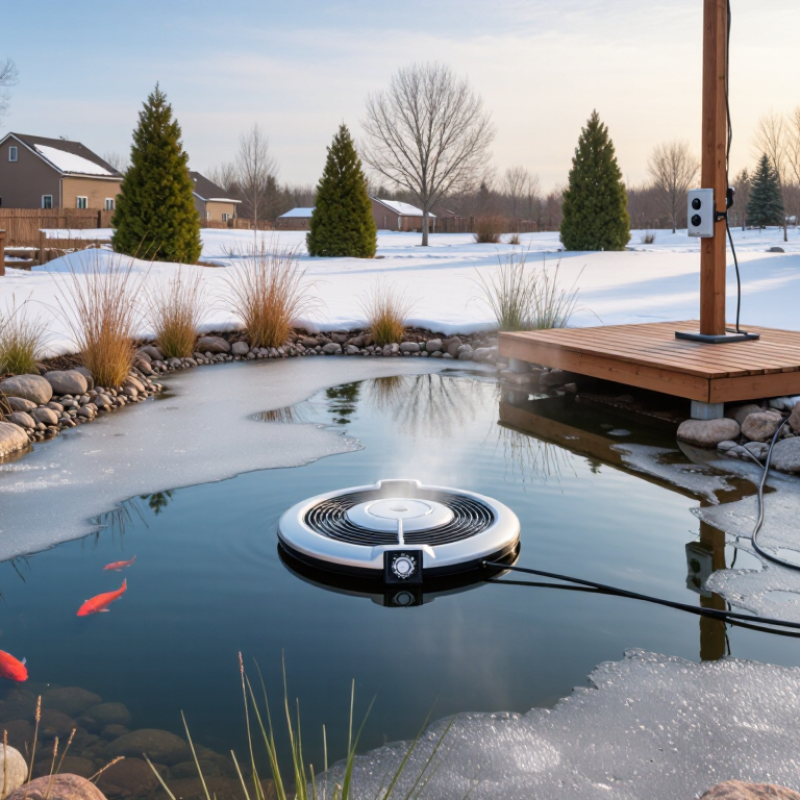
How to Choose Floating Pond De Icers in 2026?

What Floating Pond De-Icers Do and Why They Matter

Floating pond de-icers keep a small area of water open during freezing weather. They do not warm the entire pond. Instead, a built-in thermostat activates the heating element when ice begins forming. This opening supports gas exchange, which helps reduce harmful gas buildup under solid ice. Fish still need stable water conditions. A de-icer is only one part of winter pond care.

When choosing one in 2026, match its wattage to your pond’s surface area, depth, and local winter temperatures. A low-wattage model may struggle during prolonged freezes. An oversized unit can consume unnecessary electricity.

Look for automatic temperature control, durable floating construction, and a protected power cord. Keep the heating element away from liners and shallow edges. A small gap around the unit is not always enough. Ice can shift overnight.

Tips: Check the de-icer daily during severe weather. Remove snow near the opening, but never strike the ice sharply. Test the thermostat before winter arrives. Place the unit where wind will not push it into the bank. An air pump may help circulation, but it cannot replace a de-icer in every climate. My practical mistake was treating pond size as the only measurement. Weather patterns, shade, and water movement matter too.

How to Assess Pond Size, Depth, and Winter Conditions

Choosing a floating pond de-icer starts with measurements, not guesswork. Measure the pond’s length and width, then estimate its surface area. Irregular ponds need simple sections measured separately. Record the deepest point with a weighted line. Depth matters because shallow water loses heat quickly, especially beside exposed banks. A small pond may still need strong protection if it is shallow and windblown.

Do not expect a de-icer to melt the entire surface. Its main job is keeping a breathing opening in the ice. Fish require gas exchange, while trapped gases can accumulate beneath sealed ice. Match the unit’s rated coverage to the pond area, but treat that figure as a guide. Water movement, shade, and floating leaves can change performance. I once assumed a larger unit always worked better. That was too simple.

Winter conditions deserve equal attention. Note the usual lowest temperature, ice duration, snowfall, and prevailing wind. Heavy snow insulates ice, yet strong wind can expose and cool the pond quickly. In very cold regions, one unit may not protect a large or deep pond evenly. Check cord placement, water depth, and power protection before installation. A unit floating near the center may drift toward a shallow edge. That detail is easy to miss. Recheck it after storms and during prolonged freezing weather.

Which De-Icer Type, Wattage, and Design Fits Your Pond

How to Choose Floating Pond De Icers in 2026?

Choosing a floating pond de-icer starts with the pond’s purpose, depth, and winter exposure. A thermostatic floating model suits ornamental ponds with changing temperatures. A submersible unit may work better in deeper water with strong wind. Aerating systems add oxygen movement, but they may not keep a wide opening clear during severe freezes. The choice is not automatic.

Wattage must match surface area and local weather. A 300-watt unit can support a small sheltered pond, while larger or wind-exposed ponds may require 1,000 watts or more. These figures are practical ranges, not universal rules. NOAA’s 1991–2020 Climate Normals help identify local freezing patterns and cold duration. That information is more useful than guessing from calendar dates. Electricity also matters. The U.S. Energy Information Administration reported average U.S. residential electricity prices near 16 cents per kilowatt-hour in 2024. A 1,500-watt unit running continuously for 30 days could use about 1,080 kilowatt-hours, costing roughly 173 dollars.

Design details affect real performance. Choose a guarded heating element, a weighted or tethered body, and a cord rated for outdoor immersion. Keep the opening away from pond edges and shallow sediment. Inspect the cable and float after storms. In my experience, owners often oversize the heater but ignore wind direction. That is an expensive mistake. A lower-wattage unit with better placement may perform better, although this needs checking during the coldest week. Temperature control can reduce waste, but sensors sometimes respond slowly under snow or moving water.

How to Compare Safety, Energy Use, Durability, and Maintenance

Choosing a floating pond deicer in 2026 starts with the water, not the advertising claim. A 1,500-watt heater can consume 18 kWh in 12 hours. At the U.S. Energy Information Administration’s 2024 average residential rate of 16.48 cents per kWh, that equals about $2.97 daily before cycling losses, according to Electric Power Monthly. Thermostatic control matters. However, savings depend on wind, air temperature, pond depth, and placement. Record runtime with a plug-in energy meter for seven cold nights. The result may disappoint.

Safety deserves more weight than wattage. Choose a listed unit with weather-resistant connections and GFCI-protected power. The National Electrical Code requires GFCI protection in many wet outdoor locations, while UL 943 defines GFCI performance requirements. Keep the cord above the ice edge. Inspect cuts, swelling, and brittle insulation before each season. Never assume a floating body prevents contact with children, livestock, or wildlife. That assumption is weak.

For durability, compare housing material, element protection, cable flexibility, and replacement-part availability. An IP rating describes water and dust resistance, but it does not prove safe pond operation. Verify certification for the complete product. Maintenance should include removing scale, checking the float, and testing the GFCI monthly. EPA’s WaterSense program supports efficient water management, but it does not certify pond deicers. A five-year warranty sounds reassuring, yet service records often reveal more than promises.

How to Choose Floating Pond De Icers in 2026? - How to Compare Safety, Energy Use, Durability, and Maintenance

Generic De-Icer Configuration Typical Rated Power Recommended Pond Size Safety Features to Verify Energy Use at 8 h/day Typical Seasonal Cost* Durability Considerations Maintenance Level Best Use Case
Low-wattage floating de-icer 250–500 W Up to approximately 1,000 gal (3,785 L) Ground-fault circuit interrupter (GFCI/RCD), grounded plug, thermal cut-off, fully sealed electrical housing 2–4 kWh/day About $67–$134 Best in protected ponds with moderate winter ice; polymer float should resist ultraviolet exposure and cracking Low Small ornamental ponds and mild-to-moderate freezing conditions
Thermostatically controlled floating de-icer 500–1,500 W Approximately 1,000–3,000 gal (3,785–11,356 L) GFCI/RCD protection, automatic temperature control, over-temperature protection, strain relief, waterproof cable connection 4–12 kWh/day when continuously energized; normally lower when the thermostat cycles About $134–$403 before thermostat savings Thermostat and heating element should be replaceable or serviceable; stainless-steel or corrosion-resistant heating surfaces are preferable Low to moderate General-purpose winter ice prevention with reduced unnecessary runtime
High-output floating de-icer 1,500–2,000 W Approximately 3,000–6,000 gal (11,356–22,712 L) GFCI/RCD, thermal overload protection, stable float design, grounded metal parts, weather-resistant plug and cable 12–16 kWh/day About $403–$538 More exposed heating area can accelerate mineral scaling and corrosion; inspect the element more frequently Moderate Large ponds or regions with prolonged, severe freezing
Submersible, thermostatic de-icer with protective cage 1,000–1,500 W Approximately 2,000–4,000 gal (7,570–15,142 L) GFCI/RCD, enclosed heating element, automatic shutoff when exposed, weighted or secured body, protected cable entry 8–12 kWh/day when continuously energized About $269–$403 before thermostat savings Protective cages reduce contact damage from fish, wildlife, and pond equipment; avoid direct contact with liners Moderate Ponds where wind makes a surface float unstable or where a discreet installation is preferred
Floating de-icer with adjustable thermostat or timer 500–1,500 W Approximately 1,000–3,000 gal (3,785–11,356 L) Independent GFCI/RCD, sealed control enclosure, temperature sensor protection, fail-safe thermal limiter Programmable; commonly 2–12 kWh/day depending on settings and weather About $67–$403 depending on runtime More controls mean more components to protect from moisture; choose UV-resistant housing and an accessible service cover Moderate Owners prioritizing energy control and seasonal operating flexibility
Comparison notes: Energy estimates use the formula kilowatts × 8 hours × 30 days. Seasonal cost estimates assume an electricity rate of $0.14 per kWh and one month of operation; actual costs vary with thermostat cycling, weather, electricity rates, and operating hours. A de-icer helps maintain an opening in the ice rather than heating the entire pond. Always use a properly installed GFCI/RCD-protected outdoor circuit, keep connections above water and snow level, and follow the applicable electrical and installation requirements.

How to Install, Monitor, and Store a Floating Pond De-Icer

Choosing a floating pond de-icer in 2026 starts with your pond’s size, depth, climate, and winter wind exposure. Select enough heating capacity for local freezing conditions, not just the pond’s surface area. Read the manufacturer’s instructions carefully. Electrical requirements can vary.

Place the de-icer on open water, away from shallow edges, liners, plants, and plastic equipment. Use its tether to prevent drifting into a corner. Connect it to a weather-resistant, ground-fault protected outlet that follows local electrical rules. Keep the plug and connection above snow and standing water. The unit should float freely.

Check it during freezing weather. Look for a clear opening around the heater, steady bubbling, and an undamaged cord. Do not break thick ice with force near the device. A sudden impact may damage the housing or pond liner. Check water levels too, because evaporation can expose the heater. I have seen owners check only after storms, which is not enough. Daily checks are safer during severe cold. If the unit tilts, smells hot, or trips the protection, unplug it and investigate.

When winter ends, unplug the de-icer and let it cool completely. Remove mineral deposits with a soft brush and clean water. Avoid harsh chemicals. Inspect the float, heating element, cable, and seals for cracks. Dry every part before storage. Store it indoors, above freezing, with the cord loosely coiled. I once stored a damp unit in a sealed box; corrosion appeared by autumn. A breathable container would have been wiser.

FAQS

How do I choose the right floating pond de-icer?

Match the design to pond depth, surface area, wind exposure, and winter temperatures. A thermostatic float suits many ornamental ponds. Deeper, windier ponds may need a submersible unit. The choice is not automatic.

What wattage is suitable for a small pond?

A 300-watt unit may support a small, sheltered pond. Larger or exposed ponds may require 1,000 watts or more. These are practical ranges, not guarantees. Check the coldest local conditions.

Can a 1,500-watt de-icer become expensive?

Yes. Running continuously for 30 days may use about 1,080 kilowatt-hours. At 16 cents per kilowatt-hour, that could cost roughly 173 dollars. Temperature control may reduce waste, but sensors can respond slowly.

Is an aerating system enough during severe freezing?

Aeration moves oxygen and water, but it may not keep a wide opening clear. Severe freezes can overwhelm bubbling systems. Heat and airflow still matter.

Where should I place the floating de-icer?

Place it over open water, away from shallow edges, plants, liners, and plastic equipment. Use the tether to prevent drifting into a corner. Keep the opening away from sediment.

What electrical precautions are important?

Use an outdoor-rated cord and a weather-resistant, ground-fault protected outlet. Keep plugs above snow and standing water. Follow local electrical requirements. Never ignore damaged insulation.

How often should I inspect the de-icer during freezing weather?

Check it daily during severe cold. Look for a clear opening, steady bubbling, and an undamaged cord. Watch the water level too. Evaporation can expose the heater.

What should I do if the unit tilts, overheats, or trips protection?

Unplug it immediately and investigate the problem. Do not force thick ice apart near the device. Impact may damage the housing or pond liner. This needs caution, not impatience.

How should I clean and store the de-icer after winter?

Unplug it and let it cool completely. Remove mineral deposits with a soft brush and clean water. Dry every part before storage. Keep it indoors, above freezing, with the cord loosely coiled.

Can better placement outperform higher wattage?

Sometimes. Wind direction can affect the opening more than owners expect. A lower-wattage unit in a protected position may perform better. I would still check it during the coldest week.

Conclusion

Choosing the right Floating Pond De-Icers in 2026 starts with understanding their purpose: they keep a small area of water open during freezing weather, allowing gas exchange and helping protect fish and other pond life. Before buying, evaluate the pond’s surface area, depth, exposure to wind, typical winter temperatures, and the severity and length of freezing conditions. These factors determine the de-icer’s required wattage and whether a floating, thermostatic, or combination design is most suitable.

A good selection should balance heating performance with energy efficiency, electrical safety, weather resistance, and easy maintenance. Look for stable construction, protected components, and features that reduce unnecessary operation. Install the unit where it can circulate warm water without contacting liners, plants, or wildlife, and inspect it regularly for ice buildup, damage, or blocked openings. At the end of winter, clean, dry, and store the de-icer properly so it remains reliable for the next season.

Amelia

Amelia

Amelia is a professional marketing specialist with a deep understanding of the company’s products, their features, and the needs they are designed to serve. She regularly contributes expert articles to the company website, offering clear, practical insights that help readers make informed decisions......