
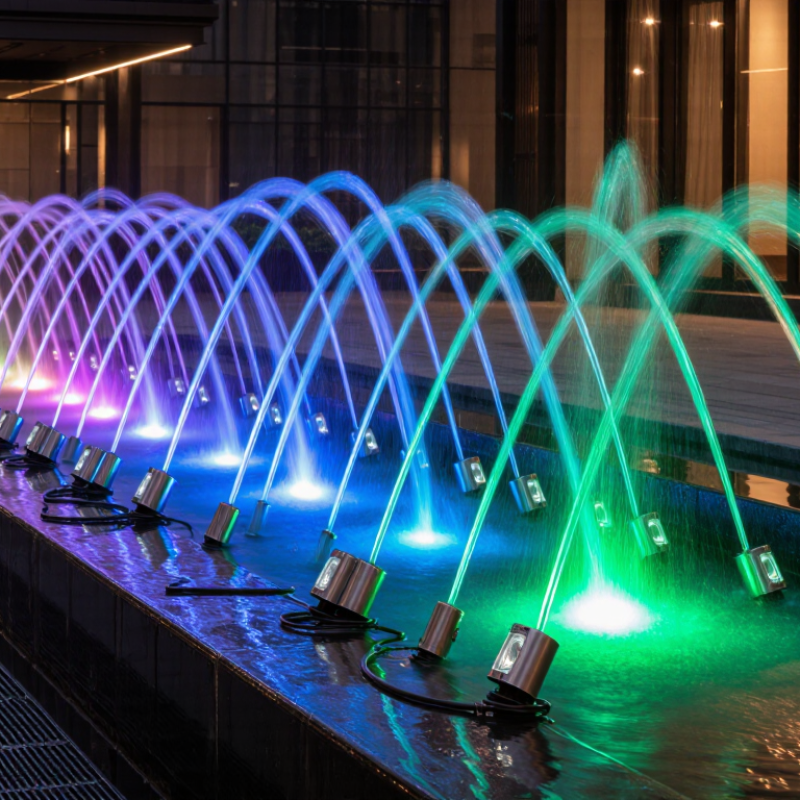
Leading fountain light suppliers focus on performance, safety, and practical installation details. Their fixtures usually offer RGBW color mixing, allowing softer whites and more accurate architectural tones. Smooth dimming matters when water movement changes during evening shows. Reliable suppliers provide sealed housings, commonly using marine-grade stainless steel or durable coated aluminum. IP68 protection helps the lights withstand continuous underwater exposure, although installation quality still matters.
Good suppliers also support DMX or other control systems with clear wiring diagrams and tested addressing procedures. Surge protection, stable drivers, and efficient heat management reduce failures inside compact underwater fixtures. Field teams should check beam angles, cable lengths, connector types, and mounting brackets before ordering. Small mismatches can delay an entire fountain project. They should not.
Technical documents should include photometric data, operating temperatures, power consumption, and maintenance instructions. Independent testing reports and traceable quality checks strengthen supplier credibility. A dependable supplier also explains warranty limits instead of hiding them in vague language. Responsive support is valuable when water pressure, cable routing, or controller settings create unexpected problems. Even strong specifications can disappoint when the supplier ignores the site conditions. A careful supplier asks for drawings, water depth, flow patterns, and local electrical requirements before recommending a fixture. Testing one sample underwater is still wiser than trusting a bright showroom photograph.
